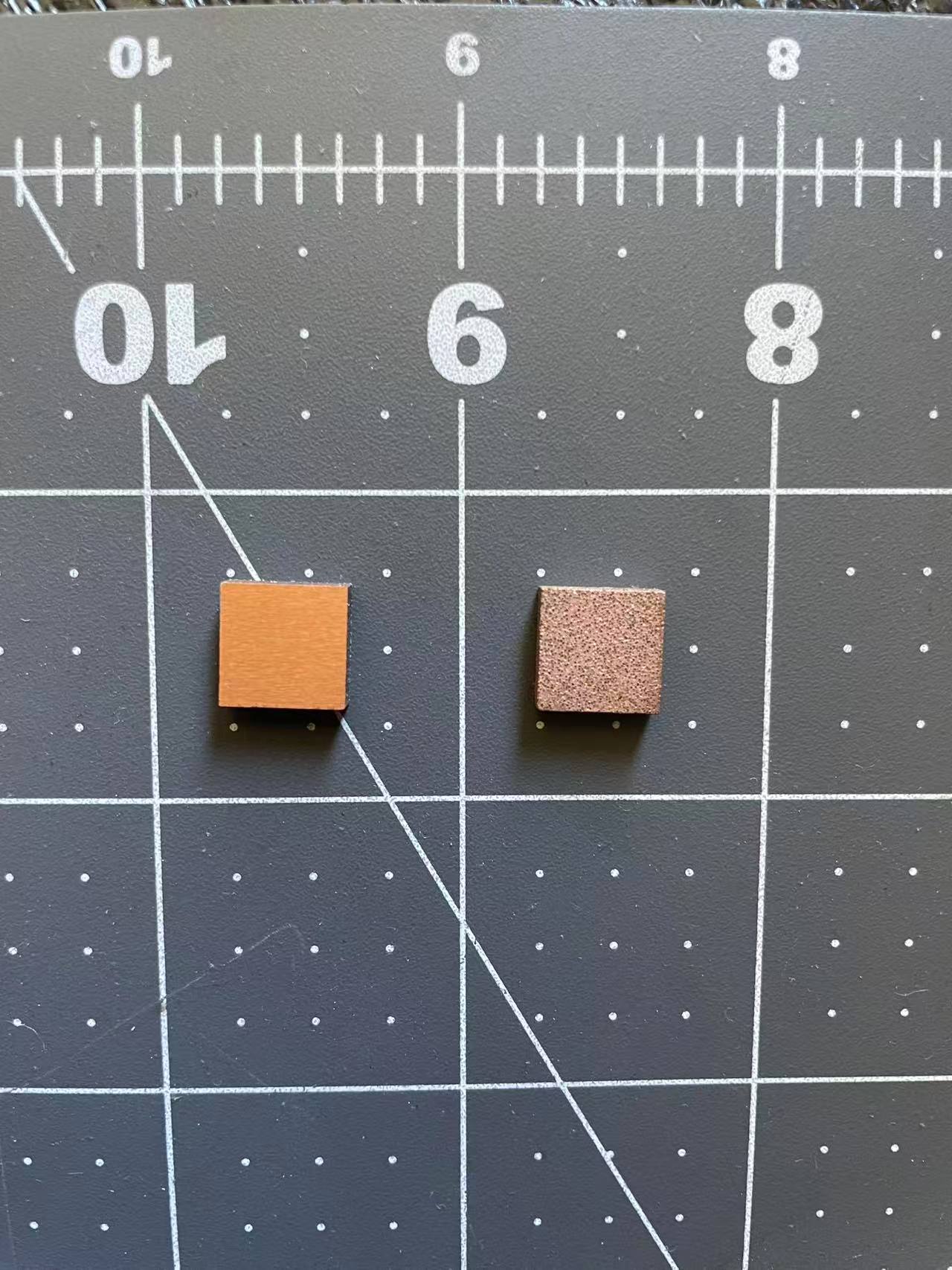
Ultrasonic Vibration Cold Manufacturing of Cu/Diamond Composites
Ultrasonic Vibration Cold Manufacturing of Cu/Diamond Composites
A Breakthrough in Next-Generation Thermal Man agement Materials
As AI processors, power semiconductors, and high-density electronic systems continue to push the limits of power density and integration, conventional thermal management materials are rapidly approaching their physical boundaries. Copper–diamond (Cu/Diamond) composites, offering ultra-high thermal conductivity (600–1000 W/m·K) and tailorable coefficients of thermal expansion (5–7 × 10⁻⁶/K), have emerged as one of the most promising candidates for next-generation heat dissipation solutions.
However, industrial adoption has long been constrained by complex and energy-intensive fabrication routes, including high-temperature high-pressure (HTHP) sintering (~1500°C, ~4.5 GPa) and multi-step interfacial coating processes (Ti/Cr/W), which significantly increase cost, limit scalability, and introduce thermal resistance at interfaces.
A groundbreaking study published in Science China Materials (2026) by the team led by Ma Jiang at Shenzhen University introduces a disruptive alternative: Ultrasonic Vibration Cold Manufacturing (UVCM). This novel approach enables one-step fabrication of Cu/Diamond composites under near-room-temperature and low-pressure conditions, fundamentally redefining the processing paradigm.
A Paradigm Shift: From Extreme Processing to Solid-State Activation
Unlike conventional sintering methods, UVCM leverages high-frequency ultrasonic energy (20 kHz) to induce localized interfacial activation through multi-physics coupling:
Mechanical-to-thermal energy conversion via high-frequency vibration
Localized frictional heating (peak ~390 K, far below oxidation thresholds)
Surface activation and oxide removal through ultrasonic cavitation
Plastic deformation of Cu particles, enabling pore-free densification
Atomic-scale interdiffusion (Cu–C) forming a 6–7 nm metallurgical bonding layer
This process enables direct metallurgical bonding without any interfacial coating, eliminating one of the most critical thermal resistance sources in traditional designs.
Process Window: Extreme Simplification with High Efficiency
| Parameter | Conventional Methods | UVCM |
|---|---|---|
| Temperature | 900–1500°C | Room temperature (~300–390 K) |
| Pressure | 4–8 GPa | ~16 MPa |
| Processing Time | Minutes–hours | < 3 seconds |
| Interface Engineering | Coating required | None |
This represents:
>80% reduction in temperature
200–500× reduction in pressure
>20× increase in processing speed
Performance Breakthrough: Beyond Commercial Thermal Materials
Experimental results demonstrate outstanding material performance:
Thermal conductivity: up to 1043 W/m·K (2.6× pure Cu)
CTE: <10 × 10⁻⁶/K (well matched to Si, SiC, GaN)
Yield strength: ~150 MPa
Relative density: >97%
In system-level thermal testing, Cu/Diamond heat spreaders fabricated via UVCM outperform commercial ceramics:
~26% lower temperature vs. AlN
~35% lower temperature vs. Al₂O₃
~15% improvement vs. pure copper
Interface Engineering Without Coatings: A Key Advantage
Traditional approaches rely on carbide-forming interlayers (e.g., TiC, Cr₃C₂), which introduce phonon mismatch and increase thermal resistance. In contrast, UVCM produces:
Direct Cu–Diamond bonding
Self-limited nanoscale diffusion layer (6–7 nm)
Reduced phonon scattering, acting as a “phonon bridge”
This fundamentally improves heat transfer efficiency at the interface level.
Manufacturing Advantages for Industrial Adoption
UVCM introduces several transformative advantages:
Near-net-shape forming of complex geometries (microchannels, thin fins <100 μm)
Programmable material properties via diamond volume fraction (0–60%)
Ultra-low energy consumption (~0.3–0.5 kWh/kg, ~96% reduction vs. HTHP)
Environmentally friendly processing (no coatings, no chemical waste)
High flexibility for small-batch and customized production
Industrial Outlook: Enabling Next-Generation Electronics
This technology is particularly suited for:
AI accelerators (GPU/TPU thermal solutions)
High-power SiC/GaN modules
Data center cooling systems
Aerospace thermal control systems
Looking ahead, UVCM is expected to evolve from laboratory validation (2026–2027) to pilot-scale production (2028–2029), with broader adoption in automotive, telecom, and advanced computing sectors.
Conclusion
Ultrasonic Vibration Cold Manufacturing represents a fundamental shift in composite fabrication, replacing extreme thermodynamic conditions with intelligent energy localization and solid-state bonding. By simultaneously improving performance, reducing cost, and enabling design flexibility, this technology has the potential to redefine the future of thermal management materials.